

View and drive a zenoh system from a browser, even over a weak link (a phone on bad wifi). A Rust library serves browsers over WebRTC; a dependency-free TypeScript client talks to it. Pictures arrive as video (H.264 by default, AV1 built in, or any encoder you plug in), sound as Opus, everything else as bytes on per-stream data channels. A per-browser bandwidth allocator decides who gets what when the link is short.
- zenoh-gateway-cli: the
zenoh-gatewaycommand, the example page and the end-to-end tests. - zenoh-dimos-codecs: ROS 2 / dimos images, depth and point clouds.
- docs/how-to.md: recipes (subscribe, publish, video, point clouds, ...). SPEC.md: the detailed contract.
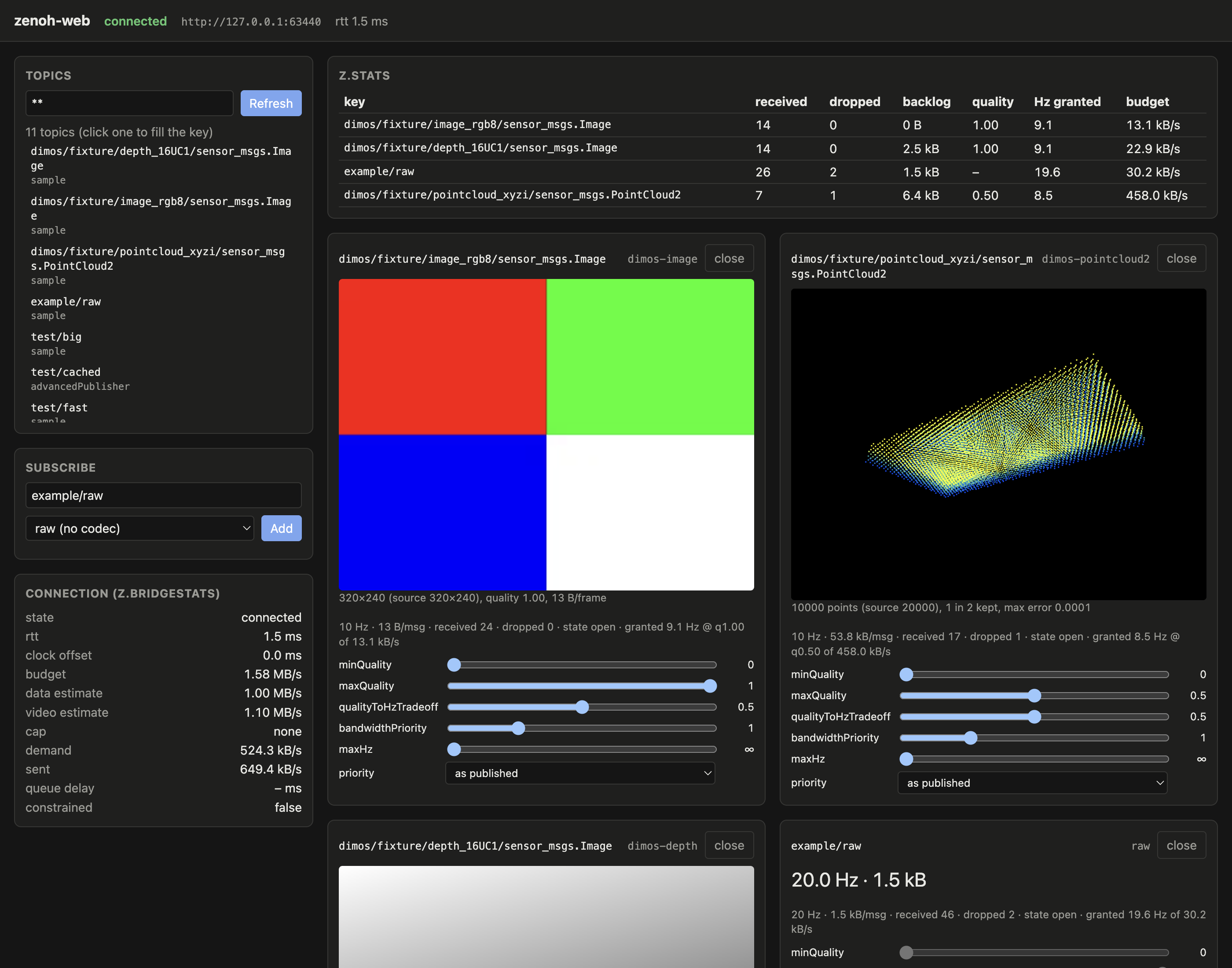
- The gateway is a normal zenoh peer or client (zenoh 1.10.1, webrtc-rs, tokio, axum) running in your process.
Browsers reach it with
POST /offer, then WebRTC. - Each subscription and publisher is its own data channel, so a slow stream never blocks another.
delivery: "latest"drops old frames;"reliable"is ordered and lossless. - Payloads are only parsed when a subscription picks an encoding, and only for frames that will be sent.
- Heartbeat + deadman: a publisher can leave a "stop" message on the gateway, published once if the page goes silent.
import { connect, Priority, registerEncoding } from "./zenoh_gateway.js" // client/zenoh_gateway.ts, bundled

const z = await connect("http://robot.local:7448", { heartbeatHz: 5, heartbeatMisses: 3 })
const sub = z.subscribe("camera/**", { encoding: "ros2_image", maxHz: 15 }, (msg) => {})
video.srcObject = sub.mediaStream
const cmd = z.publisher("cmd_vel", { priority: Priority.REAL_TIME, latencyLimit: 300 })
cmd.put(bytes)
await cmd.setDeadman(stopBytes)
Bundle it with deno bundle --platform browser client/zenoh_gateway.ts, vendor it (ddtk's tools/vendor_zenoh_client.js),
or, in a Desktop app, import the copy Desktop serves at /zenoh-gateway/client/<commit>/zenoh_gateway.js. An unknown option
or bad value rejects the subscription or publisher; ready() rejects with the reason.
| option | default | |
|---|---|---|
heartbeatHz |
0 (off) | heartbeats per second; needed for deadmen and leases |
heartbeatMisses |
3 | misses / hz seconds of silence = the page is gone |
token |
none | sent as Authorization: Bearer (Auth); a refused token rejects connect |
iceServers |
the gateway's | RTCIceServer[], fetched from GET /zenoh-gateway/ice by default |
iceTransportPolicy |
the gateway's, else "all" |
"relay" forces TURN |
linkBandwidthBytesPerSec |
estimated | the link's known speed (bytes/s) in place of the estimate; z.setLinkBandwidth(n) changes it live |
reconnect |
true |
reopen the connection and every live channel after a loss |
freshAfterMs |
2000 | a page hidden, frozen or disconnected this long starts a fresh connection instead of catching up |
statsIntervalMs |
1000 | how often z.stats / z.gatewayStats refresh |
clock |
performance.timeOrigin + performance.now() |
the page's clock in ms |
| member | |
|---|---|
subscribe(key, options, callback) → Subscription |
msg: { key, kind, bytes, encoding?, attachment?, timestamp, seq, decoded?, video?, mediaStream?, header? } |
publisher(key, options) → Publisher |
|
publishAudio(key, track, { encoding, sampleRate?, priority?, latencyLimit? }) → AudioPublisher |
a microphone to zenoh (below) |
put(key, bytes, opts), delete(key, opts) |
one zenoh put / delete |
get(key, { parameters, payload, timeoutMs = 5000, ... }), querier(key, opts) |
zenoh queries |
declareQueryable(key, { complete }, (query) => …) |
answer queries: query.reply(...), replyErr, replyDel, finalize() |
declareToken(key), livelinessSubscribe(key, { history }, fn), livelinessGet(key) |
liveliness |
matchingStatus(key, "subscribers" | "queryables"), matchingListener(key, target, fn) |
would anyone receive it |
info() → { zid, routers, peers } |
the gateway's zenoh session |
listTopics(filter = "**", { probeMs = 0 }) → [{ key, sources }] |
topics the gateway has seen, at once; probeMs listens that long first |
encodings |
[{ name, output }] the gateway runs |
stats, gatewayStats, pollStats() |
per-key counters and allocation; link estimate, budget, queue delay |
rttMs, clockOffsetMs, now() |
round trip, clock offset, the page clock |
state, onState(fn) |
"connecting" / "connected" / "degraded" / "lost" |
lease({ publish?, subscribe?, allowTakeover?, maxSeconds?, onLost?, group? }) → Lease, expireLease(group) |
exclusive publish/subscribe rights (Leases) |
iceServers, pauseHeartbeat(), resumeHeartbeat(), close() |
| option | default | |
|---|---|---|
delivery |
"latest" |
or "reliable" (not for video/audio) |
priority |
as published | zenoh 1–7 (Priority.*); ≤ 2 is strict (never degraded) |
maxAge |
none | ms; drop anything older |
maxHz |
none | never send faster |
bandwidthPriority |
1 | higher keeps more when bandwidth is short; 0 gives up first |
minQuality |
0 | the lowest quality the allocator may pick |
qualityToHzTradeoff |
0.5 (video: 1) | 0 = keep quality, drop rate; 1 = keep rate, drop quality (video: fewer bits per frame at the same size) |
encoding |
none (raw bytes) | a name from z.encodings |
channel |
from the encoding | "video-h264", "video-vp8", "video-vp9", "video-av1", "video-h265", "audio-opus" or "data" |
encodeOptions |
{} |
for the encoding; quality (0–1, default 1) is the most the allocator picks |
compress |
the encoding's | "zstd" or "none" (data channels); msg.bytes is always decompressed |
maxBitrate |
~0.3 bit/pixel | video: the most bits/s it asks for |
minResolutionScale |
0 | video: never smaller than this share (the picture keeps full size unless frames pass maxQp) |
minResolution |
[160, 64] |
video: never shrinks below this |
maxResolution |
none | video: [width, height] box the picture fits in |
frameDropping |
true | video: the encoder may skip a frame to hold its bitrate |
keyframeIntervalMs |
60000 | video: a keyframe at least this often |
targetQp |
30 | video: the quantizer a shrunk picture aims for, and grows back under (lower = smaller, sharper) |
maxQp |
37 | video: fewer bits cost compression up to this quantizer; past it the picture shrinks (libwebrtc's threshold) |
sceneChangeKeyframes |
false | video: a keyframe on a scene change |
metadata |
true |
msg.header: { stamp, sec, nanosec, frameId, seq? } from the sample |
playoutDelay |
[0, 0] |
video: [min, max] ms the browser may hold a frame; [0, 0] shows each at once |
Subscription: ready(), state, mediaStream, channelName, received, dropped, partialDropped,
decodeErrors, gatewayStats, rejectionReason, close(), and update(changes), which changes maxHz,
minQuality, qualityToHzTradeoff, bandwidthPriority, maxBitrate, minResolutionScale, maxResolution,
frameDropping, keyframeIntervalMs, sceneChangeKeyframes, targetQp, maxQp, playoutDelay or encodeOptions.quality in place, with no resubscribe (null restores a default).
| option | default | |
|---|---|---|
delivery |
"latest" |
"reliable" uses zenoh CongestionControl Block |
priority |
zenoh default | 1–7; ≤ 2 is sent express |
repeatMs |
none | re-send the last value on a timer |
latencyLimit |
none | ms; the gateway drops older puts |
Publisher: put(bytes, { timestamp }), setDeadman(bytes), clearDeadman(), state, onTripped(fn), tripReason,
blocked (why the gateway drops its puts, e.g. another client's lease), sent, dropped, ready(), close().
Microphone: publishAudio(key, track, { encoding }) sends an audio track (getUserMedia, which needs HTTPS or
http://localhost) to the gateway as Opus; the gateway decodes each packet to PCM (sampleRate, default 48000) and puts
the bytes its audio encoding's encode_pcm makes. Deadman, leases, blocked and latencyLimit (capture to arrival, clock-synced) work as above; put doesn't.
Fields messages arrive decoded in msg.decoded. For any other data encoding, registerEncoding(name, decoder)
sets msg.decoded = decoder(msg.bytes, msg). Video and audio need no decoder. Also exported: Priority (REAL_TIME
1 … BACKGROUND 7), decodeFrame, decodeFields, decodeVideoFrameInfo, encodePut.
A subscription names an encoding (how to read its messages), a channel to send the result on, and encodeOptions. Nothing is auto-detected and the core knows no message types: the application registers encodings (e.g. zenoh-dimos-codecs). No encoding = raw bytes, and rate is the only thing that degrades.
- video (
video-h264default,video-av1,video-vp8,video-vp9,video-h265): the gateway encodes pictures at the granted bitrate and sends them on a video track (sub.mediaStream). Built in: H.264 (openh264) and AV1 (rav1e, default featureav1, ~3 frames more latency). Plug in others withServerBuilder::video_encoder(e.g. VideoToolbox, or GStreamer on a Jetson); VP8 and VP9 need one. The page refuses a channel its browser can't play. - audio-opus: PCM in, Opus on an audio track.
- data: fields (built with
zenoh_gateway::Fields, decoded by the client) or the encoding's own format (decoded withregisterEncoding), optionally zstd-compressed.
Run the server in your process, give it your zenoh session (zenoh_gateway::zenoh re-exports the zenoh it uses), and
add encodings.
[dependencies]
zenoh-gateway = { git = "https://github.com/dimensionalOS/zenoh-gateway", rev = "<commit>" }
tokio = { version = "1", features = ["full"] }
let server = zenoh_gateway::Server::builder()
.connect("tcp/192.168.1.2:7447") // or .session(existing_session), or .zenoh_config(config)
.serve_dir("ui") // optional static files
.tls_files("cert.pem", "key.pem") // optional: HTTPS
.encoding(TextUppercase) // a message encoding, below
.initial_bandwidth_bytes_per_sec(64_000.0) // optional: each browser's first guess (the default)
.reliable_max_backlog(Duration::from_secs(2)) // optional: how long reliable samples wait for a slow page (the default)
.build()
.await?;
let running = server.bind(("0.0.0.0", 7448)).await?; // port 0 = any free port
println!("listening on {}", running.local_addr());
running.shutdown().await?; // deadmen fire, browsers disconnectAlso server.serve(addr), server.serve_with_shutdown(addr, signal), and server.router() (an axum Router to mount
in your own server). GET /zenoh-gateway/health answers {"service": "zenoh-gateway", "version": "..."}
(HEALTH_PATH). API docs: cargo doc --open in gateway/.
Connect to a server the way a page does, e.g. to relay a robot's streams. Video and audio arrive encoded; decode them yourself.
use zenoh_gateway::client::{Client, ClientOptions, Message, PublisherOptions, SubscribeOptions};
let client = Client::connect("http://robot.local:7448", ClientOptions { heartbeat_hz: 5.0, ..Default::default() }).await?;
let mut camera = client.subscribe("camera/front", SubscribeOptions { encoding: Some("ros2_image".into()), ..Default::default() }).await?;
while let Some(message) = camera.recv().await {
    match message {
        Message::Video(frame) => { /* frame.format, frame.data (Annex B), frame.keyframe */ }
        Message::Data(data) => { /* data.bytes, data.fields */ }
        _ => {}
    }
}
let cmd = client.publish("cmd_vel", PublisherOptions::default()).await?;
cmd.put(b"...").await?;
cmd.set_deadman(b"stop").await?;
Also client.get, list_topics, lease, expire_lease, camera.request_keyframe(), close() / closed(). A
server with no inbound ports can be reached over zenoh itself: ServerBuilder::zenoh_signalling("robot") and
Client::connect_zenoh(&session, "robot", options)
(zenoh-gateway-relay uses it). See
gateway/examples/relay_sketch.rs and SPEC "Rust client".
Implement zenoh_gateway::MessageEncoding: decode a zenoh sample into video (VideoImage::rgb8 / ::i420),
audio (AudioPcm) or a value that encode(frame, &EncodeOptions { quality, options }) turns into bytes. Optional:
output_on (other channels or options), video_encoder (e.g. pass through a camera's own H.264), estimated_bytes
(a cost model for the allocator), default_compress. Decodes are shared across browsers.
use zenoh_gateway::{Channel, DecodedFrame, EncodeOptions, EncodingOutput, EncodingSample, MessageEncoding};

struct TextUppercase;

impl MessageEncoding for TextUppercase {
    fn name(&self) -> &str { "text_uppercase" }
    fn output(&self) -> EncodingOutput { EncodingOutput::Data }
    fn decode(&self, sample: &EncodingSample<'_>, _channel: Channel) -> anyhow::Result<DecodedFrame> {
        Ok(DecodedFrame::data(std::str::from_utf8(sample.payload)?.to_uppercase()))
    }
    fn encode(&self, frame: &DecodedFrame, options: &EncodeOptions) -> anyhow::Result<Vec<u8>> {
        let text = frame.downcast::<String>()?;   // lower quality: a shorter prefix
        Ok(text.chars().take((text.chars().count() as f64 * options.quality).ceil() as usize).collect::<String>().into_bytes())
    }
}registerEncoding("text_uppercase", (bytes) => new TextDecoder().decode(bytes))
z.subscribe("chat/**", { encoding: "text_uppercase" }, (msg) => console.log(msg.decoded))zenoh-gateway-cli's examples/custom_codec.rs is a complete program.
zenoh is pinned to 1.10.1. Leave zenoh's admin space off (adminspace/enabled, the default) in a config you give the
gateway: 1.7.0–1.10.1 can deadlock answering it (the gateway warns if it's on). The webrtc-rs fixes ship as renamed
crates (zenoh-web-webrtc, ... from webrtc-rs-zenoh-web), so
dependents need no [patch] for them.
zenoh's own access_control applies to the browsers' traffic like any other on the server's session.
use zenoh_gateway::Grant;
let server = zenoh_gateway::Server::builder()
    .authorize(|token, _headers| match token {
        Some("viewer-token") => Ok(Grant { subscribe: vec!["robot/**".into()], list_topics: vec!["robot/**".into()], ..Default::default() }),
        Some("driver-token") => Ok(Grant { publish: vec!["robot/cmd/**".into()], lease_groups: vec!["drive".into()], max_lease_secs: Some(300.0), ..Grant::all() }),
        _ => Err("unknown token".into()),   // HTTP 401
    })
    .lease_group("drive", ["robot/cmd/**"])
    .build()
    .await?;
server.revoke("driver-token");   // closes its live connections
The page passes connect(url, { token }). A Grant lists allowed keys per action (subscribe, publish, query,
queryable, liveliness, listTopics, optionally delete and livelinessTokens) plus lease rights
(leaseGroups, maxLeaseSecs, forceExpire). Anything else is rejected with not authorized to <action> "<key>"
(.on_refused hears it). Grant.acl uses zenoh's ACL model instead. No hook = everyone gets Grant::all(). Issuing
tokens is up to the host (zenoh-gateway-cli's --auth-file is an example). SPEC "Auth".
const seat = await z.lease({ publish: ["robot/cmd_vel"], subscribe: ["robot/cam/**"], allowTakeover: true, onLost: banner })gives this page those rights among the gateway's clients (others' puts are dropped and their subscriptions refused;
publisher.blocked / rejectionReason say why). It ends on takeover ("takenOver"), heartbeat loss, maxSeconds,
disconnect, seat.release(), or z.expireLease(seat.group) by a client with forceExpire; onLost(reason) says
which. group: "drive" names a server-defined group (lease_group). Leases bind only this gateway's clients, not
native zenoh publishers (use zenoh's access_control). SPEC "Leases".
.ice_servers([...]) sets static servers (browsers fetch the same from GET /zenoh-gateway/ice). Minted credentials:
.turn_secret(secret, ttl) for coturn's use-auth-secret, .ice_servers_fn(|request| async { ... }) for any
provider, or .cloudflare_turn(CloudflareTurn::new(key_id, api_token)) (feature cloudflare).
.udp_ports(50000..=50100) keeps WebRTC sockets in one range for firewalls. SPEC "ICE and TURN".
With heartbeatHz set, await publisher.setDeadman(stopBytes) stores one message on the gateway. If beats stop for
misses / hz seconds, the page disconnects, or the gateway shuts down, it's published once and the publisher is
"tripped" (onTripped(reason)); make a new one to keep publishing. Background tabs throttle timers to ≥ 1 s, so keep
misses / hz well above that.
Per browser, every 250 ms: measure the link as BBR does (bandwidth = most delivered per round; round trip = least
send-to-ack time; GCC for video), split it by demand / bandwidthPriority (strict streams reserved, priority 0 shrinks
first), and pace bulk sends. Set maxAge on anything latency-sensitive: it sets how much the gateway lets queue in
the network. Numbers are in z.stats; SPEC "Bandwidth allocation".
The flake builds with crate2nix, so each crate is built once and shared
across flakes that use lib.crossRust. Linux binaries cross compile from a Mac with zig, for glibc 2.35 (Ubuntu 22.04,
Jetson L4T 36), with no VM or GCC toolchain.
nix build .#zenoh-gateway-example                  # native
nix build .#zenoh-gateway-example-aarch64-linux
nix build .#zenoh-gateway-example-x86_64-linux
Pass --max-jobs auto if your nix builds one derivation at a time.
zenoh-gateway builds against a fixed zenoh 1.10.1 (puts can be dropped after a publisher is undeclared;
eclipse-zenoh/zenoh#2832 is unreleased). [patch] doesn't carry over, so add it to yours:
[patch.crates-io]
zenoh = { git = "https://github.com/jeff-hykin/zenoh-vendor", tag = "zenoh-1.10.1-patch.1" }
nix flake init -t github:dimensionalOS/zenoh-gateway#downstream
cargo generate-lockfile && nix run github:dimensionalOS/zenoh-gateway#crate2nix -- generate
git add -A && nix build .#my-app-aarch64-linux --max-jobs autolib.crossRustPackages { name, system, cargoNix, ... } gives <name>, <name>-aarch64-linux, <name>-x86_64-linux
(see the template's flake.nix). Don't make the input follow another nixpkgs; shared pins are what let crates be
shared.
cd gateway && cargo test --all-features && cargo clippy --all-features --all-targets && cargo doc --no-deps
deno task check                            # type-check the client
bin/test                                   # every suite whose inputs changed since it last passed (--all, --list, or name some)
bin/test also runs the browser suites in client/test (headless Chrome, shaped links). The end-to-end suites (real zenoh peer, server and headless Chrome) live in
zenoh-gateway-cli.
- Encodings shipped from the browser as WASM are not yet implemented.
- Topic listing knows a topic from its liveliness token, or from messages the gateway received on it (any page's
subscription, or a
probeMslisten). A quiet topic with neither is missing until it publishes during a probe. - The default video encoder is software H.264: each stream costs CPU unless the server has a hardware encoder.
- Changes to certain keys, like
delivery,priority, the encoding, orencodeOptionsrequire a re-subscribe to take effect